Back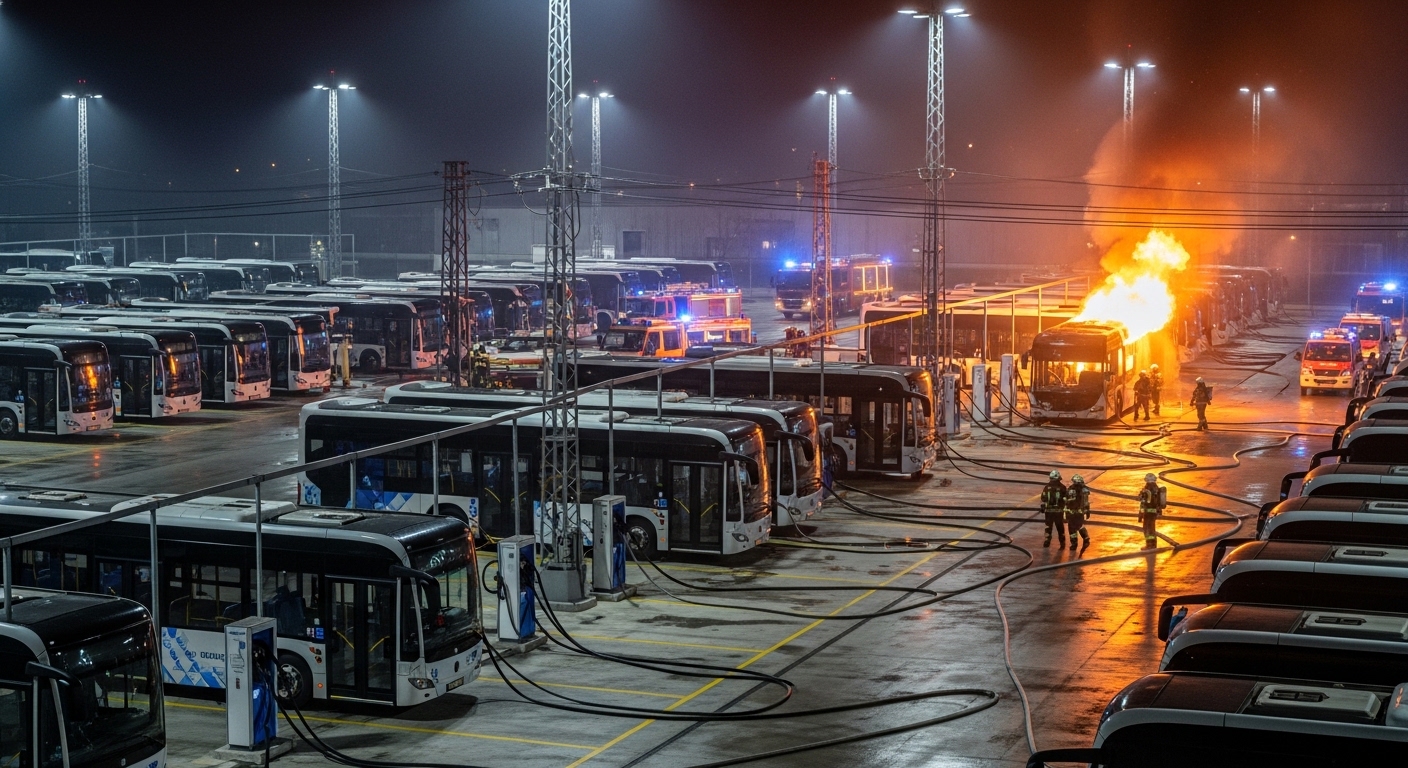
2026-01-28/Drew Hanover
The Quiet Fire Risk Hiding in Every Electric Bus Depot
On June 5, 2025, a fire broke out at a Philadelphia bus yard before sunrise. By the time crews had it under control, 40 buses were damaged and 16 were destroyed. It took 150 firefighters. The cause: a lithium-ion battery in a parked, decommissioned Proterra electric bus — one that wasn't even plugged in.
Cities around the world are racing to electrify their transit fleets. It's the right long-term direction. But the infrastructure to store and charge those fleets is introducing a new category of fire risk that most transit agencies are only beginning to reckon with.
A Scale Problem
The United States now has over 7,000 full-size zero-emission buses operating across the country — a 14% increase from 2023 alone. New York leads with 779. California has 2,285. The Federal Transit Administration committed nearly $1.5 billion in 2024 to fund hundreds more.
London's fleet is comparable in scale. The city operates thousands of double-decker and single-deck electric buses across its network, with more added every month.
Each one of those buses is a lithium-ion battery pack on wheels. And when they park overnight at a depot — often in close proximity to each other, plugged into charging infrastructure — the conditions for cascading failure become very real.
The Philadelphia incident wasn't a first. A Proterra battery also caught fire at SEPTA's Southern Bus Depot in 2022. Federal regulators have now documented at least five Proterra bus fires between 2015 and 2025.
London Learned the Hard Way
In January 2024, an electric bus caught fire on Wimbledon Hill Road. Three engines and 15 firefighters responded. The same month, a separate fire broke out at Putney bus garage in Chelverton Road. Go-Ahead Group immediately initiated safety checks on approximately 380 electric buses across their fleet.
Two fires. One month. One city.
Transport for London said the two incidents were unrelated. That's technically reassuring. It's also the wrong framing. Unrelated fires from independent lithium-ion failure events are not evidence that the risk is low — they're evidence that the risk is systemic. You don't need a single chain of cause-and-effect. You just need enough batteries, enough energy density, and enough time.
The Charging Window
18 to 30% of all EV fires occur during charging. Another 2% happen within an hour of disconnection.
Transit agencies typically charge overnight — exactly the window when staff is thinnest and response times are slowest. The Seoul underground garage fire in August 2024 damaged 900 vehicles and injured 20 people. It started with a single EV during an overnight charge.
Bus depots create a compounding version of this problem. In a dense depot, vehicles sit in rows. Charging cables run between them. A thermal event in one vehicle can spread to adjacent buses before anyone knows it's happening.
The Putney fire was caught early. Not all of them are.
Trams and Light Rail: A Different Problem, Same Physics
Electric trams present a variation of the same hazard. Tram batteries are typically charged at depot maintenance facilities between service runs — often overnight, in enclosed maintenance sheds.
The physics don't change in an enclosed shed. They get worse.
Underground parking facilities account for 25% of all EV fire incidents but 70% of vapor cloud explosion fires. Enclosed spaces trap toxic gases. Limited ventilation allows hydrogen fluoride — one of the primary byproducts of lithium-ion thermal runaway — to accumulate rapidly. When a thermal event occurs indoors, the consequences escalate far faster than in an open lot.
For cities like San Francisco, Boston, Amsterdam, and Zurich — with substantial tram networks and underground or enclosed maintenance facilities — the exposure is significant.
Why You Can't Extinguish a Lithium Fire
Here's what makes lithium-ion battery fires categorically different from every other industrial fire hazard.
When a lithium cell enters thermal runaway, it generates its own oxygen through chemical decomposition. You cannot smother it. You cannot starve it of air. Standard ABC dry chemical extinguishers suppress the visible flame but do nothing for the internal thermal reaction. The fire continues inside the battery pack while appearing to be out.
Temperatures inside a battery pack in runaway can exceed 1,000°F. EV fires overall burn at 1,200–2,700°C — versus 815–1,000°C for a conventional vehicle fire.
Water helps, but not the way most people think. The goal isn't to extinguish the fire — it's to cool the pack below the threshold where adjacent cells enter runaway. That requires volume. A Tesla fire in one documented case required 24,000 gallons over 40 minutes. An electric semi-truck fire required 50,000 gallons.
And there's reignition. Documented cases show batteries reigniting up to 68 days after the initial event. A battery pack that appears extinguished can restart thermal runaway hours or days later from residual heat trapped inside the cell stack.
For a depot with 50 buses parked in a row, "extinguished" is not the same as "safe."
The 13% That Come Back
A 13% reignition rate has been documented for lithium-ion battery fires.
Think about what that means operationally. A bus catches fire at 2AM. Crews respond, suppress the visible flames, and clear the scene by 4AM. The bus is considered handled. By the following afternoon — or three days later — thermal runaway resumes in the same pack.
This isn't theoretical. It's documented. And it's the reason why the standard protocols for EV fire response involve extended monitoring periods — sometimes 24 to 72 hours of continuous observation after apparent extinguishment.
Most transit depots are not set up to do that.
Why Early Detection Is the Only Rational Strategy
Suppression of a lithium-ion battery fire is enormously expensive, water-intensive, and unreliable. Reignition risk makes clearance uncertain. Total loss of the vehicle is common even in cases where response was rapid.
The only intervention that actually works is catching the thermal event before it becomes a fire.
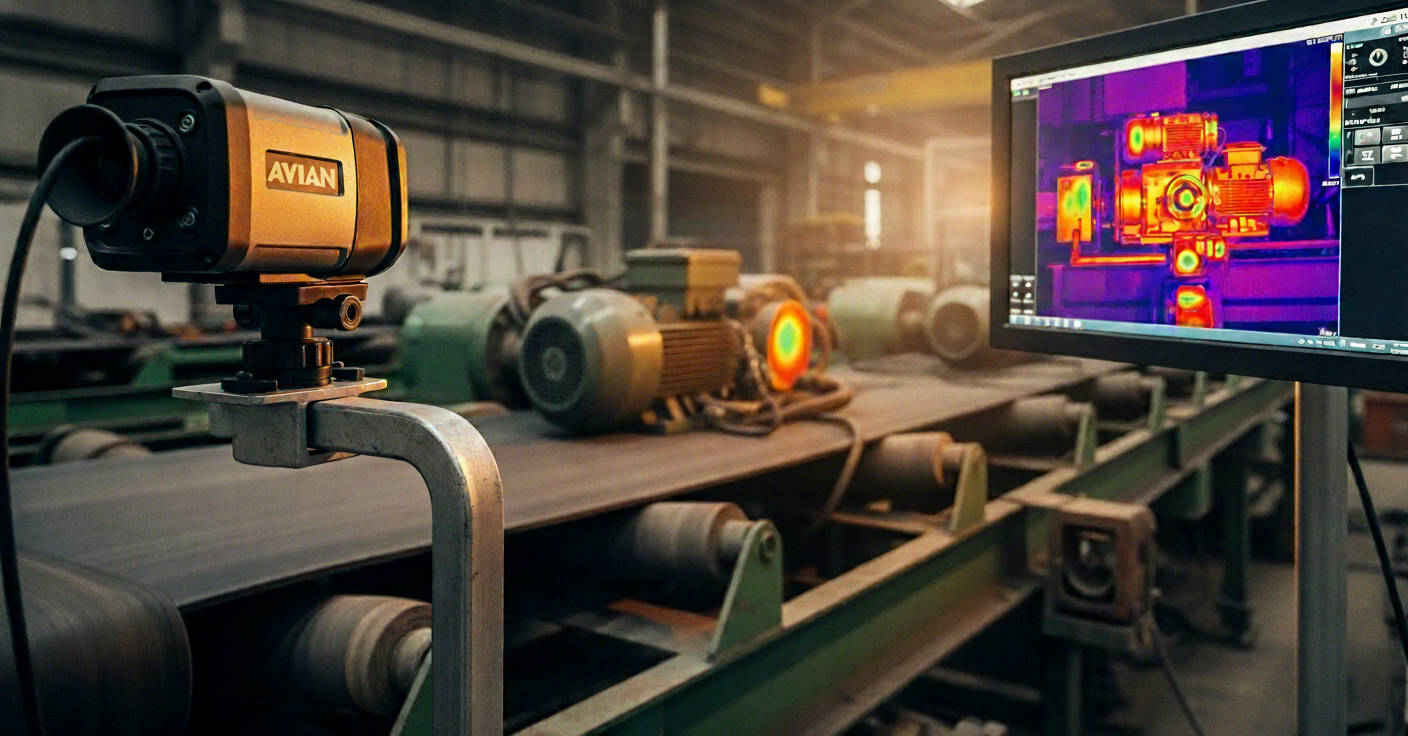
Lithium-ion thermal runaway has a signature. Before flames, before smoke, before gas venting — there is heat. A cell that is entering runaway will generate an intense, localized temperature rise that begins well before ignition. That heat is invisible to the naked eye. It's unmistakable to a thermal camera.
The window between the onset of thermal runaway and full ignition is measured in minutes. Sometimes tens of minutes. That's the window where intervention is possible — isolating the vehicle, moving surrounding buses, alerting response teams before the event escalates.
Once the battery is burning, the playbook is largely: contain the spread, apply enormous quantities of water, and wait.
Detection before ignition is not a premium option. It's the only option that actually prevents the loss.
What Transit Agencies Need to Demand
The transit agencies moving fastest on electrification are the ones acquiring the most risk. A fleet of 50 electric buses in a single depot, charged overnight in enclosed bays, with standard smoke detection overhead — that's a system that will detect a lithium fire after it's already burning.
The Philadelphia yard had decommissioned buses with disconnected batteries. The fire still destroyed 16 of them. The failure mode doesn't require active charging. It doesn't require operation. It requires a damaged or degraded lithium cell and enough time.
Transit facilities managing electric fleets need:
- Continuous thermal monitoring of charging areas, storage bays, and maintenance sheds — not smoke detectors, which activate after ignition.
- Automated alerting that reaches on-call staff immediately, without requiring someone to be watching a screen at 2AM.
- Zone-based detection that identifies which vehicle, in which bay, is developing a thermal anomaly — so responders arrive with information, not guesses.
- Baseline-adaptive algorithms that account for ambient temperature variation, seasonal changes, and the different thermal profiles of vehicles at various charge states.
Smoke detectors are a last resort. Sprinklers are damage control. Neither prevents the event that destroys a fleet.
The Window Is Closing
Cities have committed to electrification timelines they're not going to walk back. New York targets a 100% zero-emission bus fleet by 2040. Los Angeles, Chicago, Seattle, and dozens of European cities are on similar trajectories.
The risk that comes with those fleets is manageable. But it requires treating it like the thermal problem it is — not the smoke problem that traditional detection infrastructure was built for.
A lithium battery fire caught during thermal runaway is an incident. A lithium battery fire caught by a smoke detector is a catastrophe.
The buses are already in the depots. The question is whether the detection is ready for them.
Want to learn how AVIAN's thermal monitoring can protect your fleet facility? Talk to our team today.
Drew Hanover
CTO & Co-Founder