Back
2026-02-19/Drew Hanover
FLIR vs. AVIAN: What You Actually Need for Industrial Thermal Monitoring
If you're looking into thermal monitoring for your facility, you've probably come across FLIR. They're the biggest name in thermal imaging, and for good reason. They make excellent cameras.
But here's something most people learn the hard way: buying a thermal camera and having a thermal monitoring system are two very different things.
We get asked about FLIR a lot. Our customers frequently compare us before choosing AVIAN. So let's break down the differences honestly — because the right choice depends on what problem you're actually trying to solve.
FLIR: The Camera Company
FLIR (now part of Teledyne) builds some of the best thermal sensors on the planet. Their fixed-mount cameras like the A500f and A700f are solid hardware. High resolution. Wide temperature ranges. Good industrial build quality.
What you get with a FLIR camera is exactly that — a camera.
You get a sensor that captures thermal data. You get basic on-board measurement tools: spot meters, boxes, isotherms. You can set manual temperature thresholds. When a threshold is crossed, you get an alarm via Modbus, MQTT, or email.
That's a solid foundation. But it's a foundation you have to build on yourself.
To turn a FLIR camera into a monitoring system, you need to:
- Configure regions of interest manually for every asset you want to monitor
- Set static temperature thresholds and hope they account for seasonal variation, shift changes, and load differences
- Build or buy software to aggregate data, trend temperatures, and generate meaningful analytics
- Integrate with your control systems using your own engineering resources
- Manage and maintain the entire software stack over time
Many facilities buy FLIR cameras expecting turnkey protection. What they get is a powerful sensor that still needs significant engineering effort to become a useful monitoring solution.
AVIAN: The Monitoring System
We started from the other direction. We didn't build a camera and then figure out what to do with the data. We started with the problems — fires, equipment failures, unplanned downtime — and built a complete system to solve them.
Yes, we manufacture our own thermal cameras. But the camera is just the starting point.
Here's what comes with every AVIAN installation:
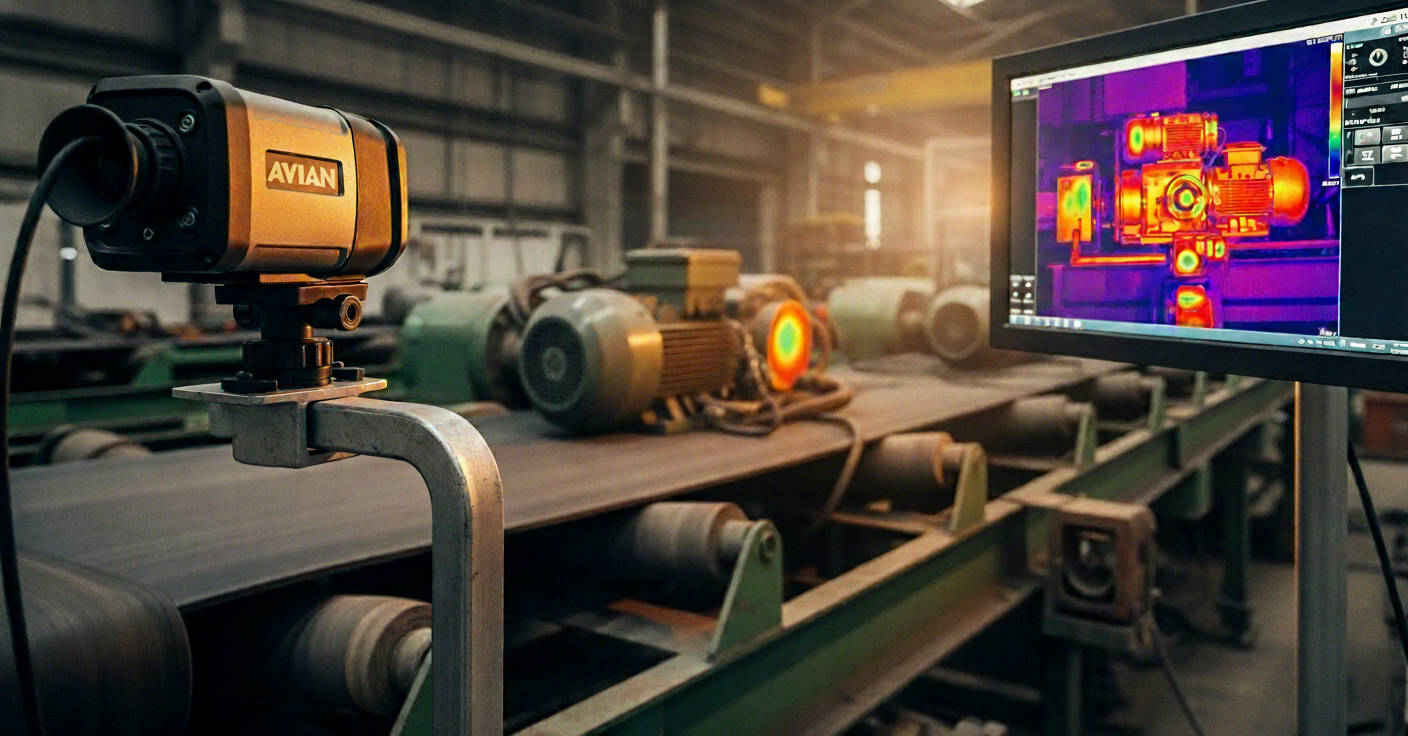
Adaptive AI thresholds. Our algorithms learn the normal operating temperature of every asset in the camera's field of view. Not a static number you set once — a dynamic baseline that adjusts for time of day, load conditions, and seasonal patterns. When a roller bearing starts running 15°C above its own normal, we catch it. A static threshold set at 200°C would miss it entirely.
Automatic anomaly detection. You don't need to draw regions of interest or configure measurement zones. Our system analyzes the entire thermal field continuously. When something deviates from normal, we flag it — even if you didn't know to look for it.
Predictive maintenance analytics. Temperature data is trended over weeks and months. Our AVIAN Analytics dashboard shows you how your equipment behaves over time, highlights degradation patterns, and tells you exactly which component needs attention and when.
Instant multi-channel alerts. When we detect a critical event — a fire, a rapid temperature spike, a trending anomaly — alerts go out immediately via text, phone call, and email. Not just a Modbus flag that someone needs to be watching a screen to notice.
PLC integration for automated response. Our system can tie directly into your PLC to trigger emergency shutdowns, activate suppression systems, or stop production automatically. No human delay. No reliance on someone being at the right screen at the right time.
Plug-and-play deployment. One cable. Plug it in. Live in minutes. No SDK development. No custom software. No IT project.
The Real Difference: Hardware vs. Intelligence
Think of it this way.
A FLIR camera is like buying a high-end security camera and mounting it on your wall. You get great footage. But you need someone watching the monitors 24/7, you need to decide what to look for, and you need to figure out how to respond when something happens.
AVIAN is the camera, the monitoring team, the alert system, and the response protocol — all in one.
Our AI doesn't just measure temperature. It understands temperature behavior. It knows that your planer's cutting heads run hotter during the first hour of a shift. It knows that ambient temperature drops at night affect your baseline. It knows that a 5°C drift on a motor bearing over two weeks is more concerning than a 20°C spike caused by a passing forklift.
This kind of intelligence doesn't come from on-camera analytics with 10 configurable spot meters. It comes from algorithms trained on millions of hours of real industrial thermal data.
Where FLIR Makes Sense
Let's be fair. There are situations where a FLIR camera is the right tool.
If you have a dedicated reliability engineering team with experience building custom monitoring infrastructure, FLIR gives you a flexible platform to build on. If you're integrating thermal data into an existing SCADA system where you already have the software layer, a FLIR sensor might slot in nicely. If you need a one-off thermal measurement for a specific R&D or quality-control application, FLIR's range of products is hard to beat.
FLIR also covers a much broader range of applications — from handheld inspection cameras to drone payloads to laboratory instruments. They're a general-purpose thermal imaging company serving dozens of industries.
Where AVIAN Wins
If you run a sawmill, planer mill, recycling facility, or any operation where fire prevention and equipment uptime are critical — and you don't want to build a monitoring platform from scratch — AVIAN is purpose-built for your world.
Our system was designed from day one for wood processing and industrial manufacturing. We understand what a stuck board looks like in thermal data. We know how dust extraction fires develop. We've seen what bearing failure patterns look like across hundreds of installations.
That domain expertise is baked into our algorithms. It's not something you can replicate by buying a camera and writing threshold rules.
Here's what our customers consistently tell us:
- Faster time to value. Live in minutes, catching issues in the first week. No months-long integration project.
- Fewer false alarms. Adaptive thresholds mean alerts are meaningful, not noise. Our system even filters out known heat sources like forklifts passing through.
- Real predictive maintenance. Not just "the temperature crossed 200°C." Our analytics show
- Peace of mind after hours. Our cameras don't go home at 5PM. When a fire starts at 2AM, you get a phone call. FLIR sends a Modbus flag.
The Bottom Line
FLIR makes world-class thermal sensors. We're not here to say otherwise.
But a sensor is not a solution. The value isn't in capturing thermal data — it's in understanding it, acting on it, and preventing the failures and fires that cost your operation tens of thousands of dollars per incident.
If you want a camera, buy a FLIR. If you want a system that prevents downtime and fires while paying for itself in 90 days, that's what we built AVIAN to do.
Want to see how AVIAN compares for your specific facility? Schedule a call with our team and we'll walk you through a side-by-side analysis.
Drew Hanover
CTO & Co-Founder